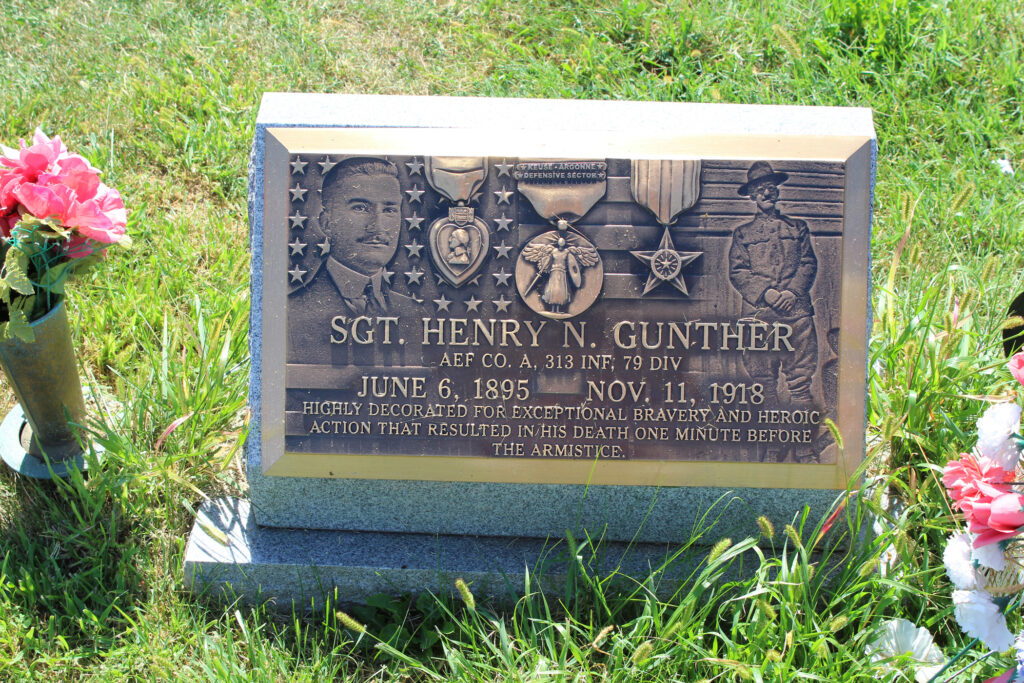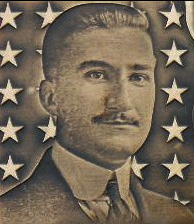
Last American soldier killed in World War I. Sgt. Gunther, at age 23, was killed on 11 Nov 1918, at 10:59 am, just one minute before the Armistice was to take effect at 11:00 am.
Born 6 Jun 1895 in Baltimore, MD to George and Magdelena (Roth) Gunther.
Inducted on 30 Sep 1917, assigned to Co. A, 313th Infantry Regiment, 79th Division, American Expeditionary Forces (AEF).
Deployed to France in July, 1918.
Sgt. Henry Nicholas Gunther was demoted from sergeant to private soon after his arrival in France, after a letter he wrote to a friend back home was intercepted by military censors. In this letter, he described the “miserable conditions” at the front and advised his friend to avoid the draft. This was deemed to be evidence of disloyalty and detrimental to morale.
According to friends in his unit, his demotion affected him deeply and unfortunately came at a time when anti-German sentiment was on the rise in the U.S. It was also at this time that President Woodrow Wilson warned of disloyalty within the nation, and the military was taking a firm stance against any perceived disloyalty in the ranks.
“Gone West”
On the morning of 11 Nov 1918, the 313th was advancing towards the German stronghold of Metz, at the at the confluence of the Moselle and the Seille rivers in the northeast of France. Henry Gunther’s platoon encountered two German machine gun squads blocking a road near the village of Chaumont-devant-Damvillers and were forced to take cover. The Germans were firing not to kill, but to ward off the advancing Americans as the “11th hour, of the 11th day, of the 11th month,” was but minutes away.
Shortly after halting and taking cover, Henry Gunther decided to charge one of the machine-gun nests with fixed bayonet, in spite of orders from his commanding officer to stay put. In an attempt to stop his advance, the Germans frantically waved him off and fired a few rounds over his head. undaunted, Gunther pressed on until he was within a few yards of their position. With no recourse but to defend themselves, the Germans fired, killing him instantly.
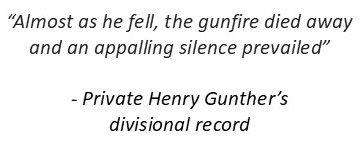
No one knows what motivated Henry Gunther to charge that bunker knowing that in just minutes the firing would cease and the war would end. Was he hell-bent on restoring his reputation, something he most certainly did in death, or did he suspect that he and his unit were about to be crushed by enemy fire? The scribes in heaven have recorded Sgt. Gunther’s mindset and motivation, but the world will forever wonder.
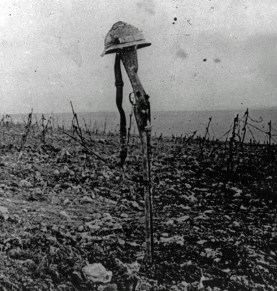
Sgt. Henry Nicholas John Gunther was posthumously awarded the Distinguished Service Cross and a Divisional Citation for Gallantry in Action; He “displayed exceptional bravery and heroic action in an attack on a machine gun position at Ville-devant-Chaumont on November 11th, 1918.” The U.S. Army subsequently restored his rank.
We pay special honor to Sgt. Henry Gunther as we do all Americans who have paid the ultimate sacrifice in defending our freedom and preserving our liberties.