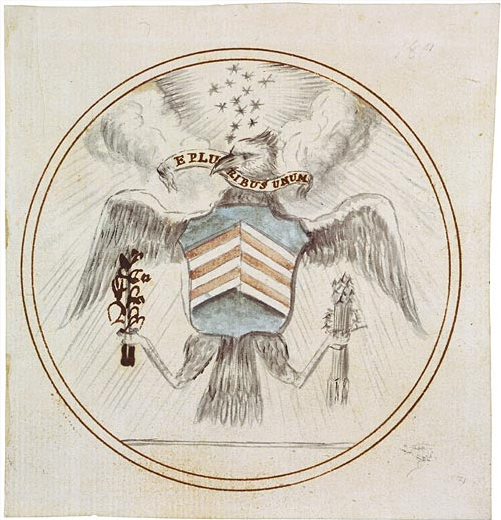
Citation: Charles Thomson’s design for the Great Seal of the United States, 1782; Reports of Committees of Congress; Records of the Continental and Confederation Congresses and the Constitutional Convention, 1774-1789, Record Group 360; National Archives
The Great Seal of the United States is considered the “national coat of arms” and official emblem for the government. It is used to authenticate government documents such as treaties, presidential proclamations, federal warrants, and commissions and to identify official government functions. It is also an integral part of the adornment on U.S. embassies, military uniform buttons and some headgear, passports, and other official paper.
Very soon after the signing of the Declaration of Independence in July 1776, a committee was formed by the Continental Congress to design an official seal for the United States. That committee, Benjamin Franklin, John Adams, and Thomas Jefferson were charged to bring in a device for a seal for the United States of America. Six years, two additional committees, and many iterations later, the task still lay unfinished.
On 13 Jun 1782, the work accomplished to date and recommendations from the various committees were turned over to Charles Thomson, Secretary of the Continental Congress, who had a reputation for getting things done. He selected the best features of all of the previous designs, giving prominence to the American Bald Eagle, replacing the crested Imperial Eagle, offered by a young Philadelphia lawyer, William Barton.
The most prominent feature of the seal is the American Bald Eagle, holding an olive branch and arrows, symbolizing peace and war. Each element, such as the 13 stripes on the shield and the motto “E Pluribus Unum,” carries significant meaning, often referencing the original thirteen states.
The Great Seal of the United States was officially adopted by the Continental Congress on 20 Jun 1782.
Learn more about the Great Seal of the United States Here…