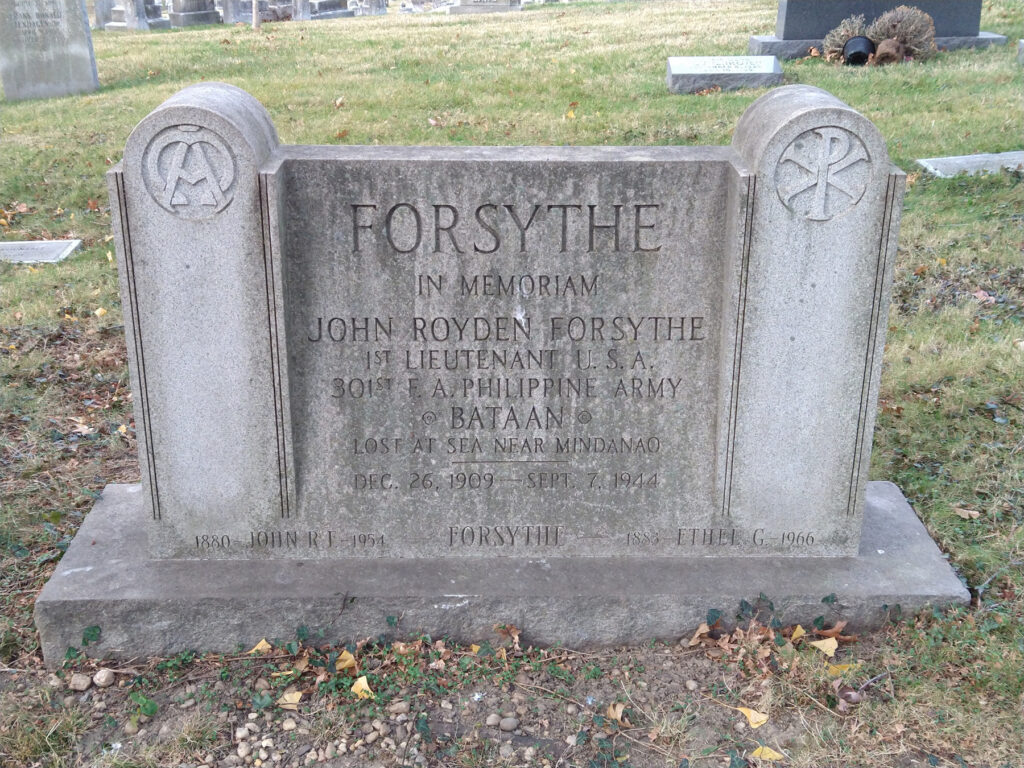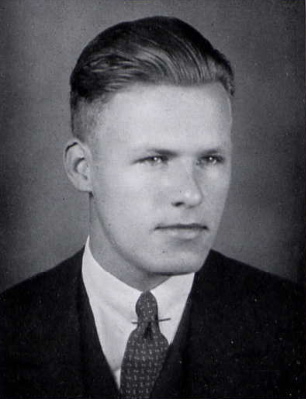
Born 26 Dec 1909, in Baltimore, MD to John Royden and Ethel Lura (Gosnell) Forsythe, Sr.
Graduated from Forest Park Sr. High School and entered Johns Hopkins University in 1928.
Pursued a Liberal Arts education while also participating in the University’s Army R.O.T.C. program, graduating in 1932.
Deployed to the Philippines with the 88th Field Artillery Regiment (Philippine Scouts), assigned to support to the 301st Field Artillery regiment of the Philippine Army.
Lt. John Royden Forsythe, Jr. was born on 26 Dec 1909, in Baltimore, MD to John Royden and Ethel Lura (Gosnell) Forsythe, Sr. John Sr. was a successful Baltimore architect, graduating from the Maryland Institute in 1897; he would be associated with established architects Frank E. Davis, Jackson C. Gott, J. E. Laferty, and the Ordinance Department of the U.S. Navy in Baltimore. His own work can be found in Pulaski, VA (Bank and Opera House, 1919) and in Baltimore (St. Johns Church, 1919; St. James Hotel, 1923; Methodist Protestant Headquarters, 1923; Caswell Hotel addition, 1909). (Credit: Sandra L. Tatman, Philadelphia Architects & Buildings).
John graduated from Forest Park Sr. High School and entered Johns Hopkins University in 1928. Known as “Roy,” he would pursue a Liberal Arts education while also participating in the University’s Army R.O.T.C. program, graduating in 1932 with a reserve commission of 2Lt, U.S. Army. Soon after graduation, he would move to Youngstown, Ohio where he would work in the insurance industry for the Maryland Casualty Company.
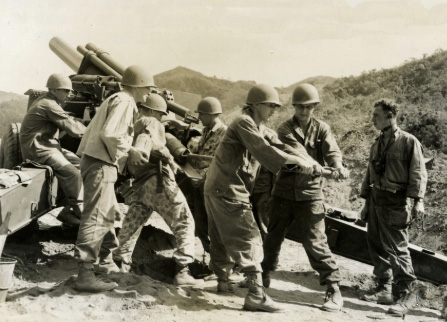
Called into service after the attack on Pearl Harbor, Lt. John F. Forsythe, Jr. would deploy to the Philippines with the 88th Field Artillery Regiment (Philippine Scouts), assigned to support to the 301st Field Artillery regiment of the Philippine Army. The unit provided artillery support during the Battle of Bataan with gun emplacements at Lingayen Gulf. The 88th Field Artillery Regiment, surrendered at Bataan on 9 Apr1942, as part of the largest American surrender in history. Lt. Forsythe, along with an estimated 78,000 American (12,000) and Filipino (66,000) soldiers, would be forced to undertake a 60-mile march from the town of Mariveles on the southern tip of the Bataan peninsula to the rail yards at San Fernando, a horrific trek that would forever be known as the “Bataan Death March.”
Along the route, additional prisoners were collected from the town of Bagac. It is recorded that at least 600 Americans and 5,000 Filipinos died enroute due to the extreme brutality of the Japanese soldiers charged with escorting them; prisoners were starved, beaten and kicked throughout the march, some to satisfy the sadistic pleasures of the guard’s, others because they were struggling to march. Those who became too weak to walk were bayoneted, shot and even beheaded, ultimately being left to die along the roadside. At San Fernando, the prisoners were packed into unventilated boxcars and transported to Camp O’Donnell, a prison camp located at Capas in the Tarlac Province. From there, many were disbursed among several other POW camps throughout the empire.
Lt. John Forsythe would be transferred to Prisoner of War Camp #2 at Davao on the Island of Mindanao in the Philippines. The prison was originally established as the Davao Penal Colony in 1932 by then US Governor General of the Philippines, Dwight Davis. Initially used by the Philippine-American Armed Forces at the outset of the war, the Japanese Imperial Army attacked Davao on 20 Dec 1941, seizing the colony for use as a POW camp. Some two-thousand American prisoners would be held at the camp after the Battle of Bataan and the Japanese conquest of the Philippines. The camp reverted to the Philippine government after the defeat of the Japanese Empire in 1945 and reopened on 2 Aug 1946. It remains in operation today as the Davao Prison and Penal Farm.
In August 1944, after more than two years of captivity, 750 prisoners of war, mostly Americans, were loaded on board an old Japanese merchant freighter, one of the infamous “Hell Ships” for transport north to Manila; these ships were named as such due to inhumane treatment by the Japanese guards and the unsanitary conditions onboard which amounted to nothing short of torture.
General Douglas MacArthur had promised to “return” to the Philippines after being driven out in March of 1942, and by August of 1944, plans had been laid to take back that which had been lost two years before. With the pending invasion, which would take place on 20 Oct 1944 on the island of Leyte, the Japanese command moved to prevent the liberation of their prisoners in the Philippines. The “Hell Ships” would be the primary conveyance deployed to move thousands of prisoners north to Manila and other POW Camps within the Japanese Empire.
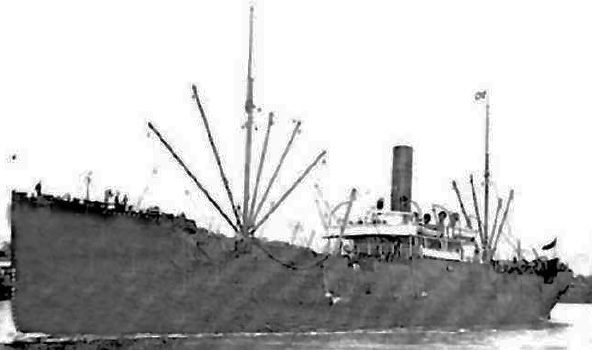
The Shinyō Maru was not marked as carrying POWs and American Intelligence had reported that it was transporting Japanese soldiers and equipment.
Leading a convoy north to Manila on 7 Sep 1944 that included torpedo boats, tankers, and four other cargo ships, it was torpedoed off Sindangan Point, Mindanao by an American submarine, the USS Paddle.
The ship sank quickly, taking 668 prisoners of war and dozens of Japanese soldiers with her to Davy Jones’ locker.
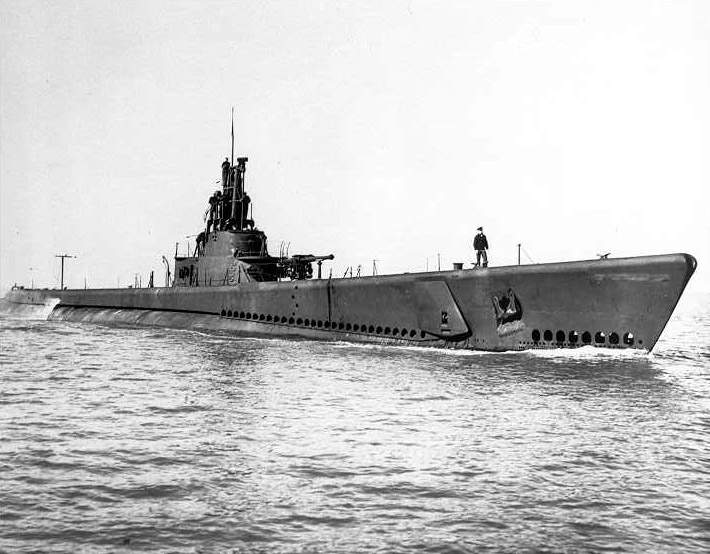
The prisoners would not go down without a fight though, and many were shot or killed by grenades thrown into the holds while trying to escape the sinking ship. Lt. John F. Forsythe was one of them; post war testimony from survivors would confirm that he was shot to death while making his escape. Eighty-three POWs would survive and swim to shore where they were rescued and sheltered by Filipino civilians (sadly, one would die the next day) later to be evacuated by the American submarine, the USS Narwhal.
1st Lt. John Royden Forsythe’s body, along with the bodies of 667 of his comrades, was never recovered. No recovery effort was ever undertaken to recover the dead of the Shinyō Maru.
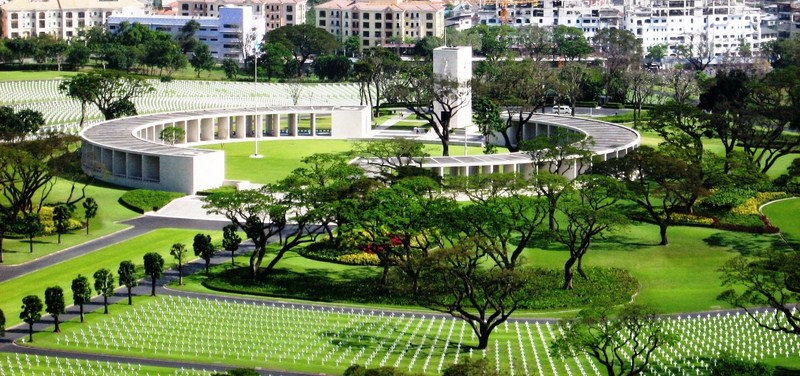
Posthumously awarded the Prisoner of War Medal and the Purple Heart, he is memorialized in perpetuity on the “Tablets of the Missing” at the Manila American Cemetery in the Philippines. He is also memorialized on the family monument that includes his parents at Green Mount Cemetery in his hometown of Baltimore, MD.