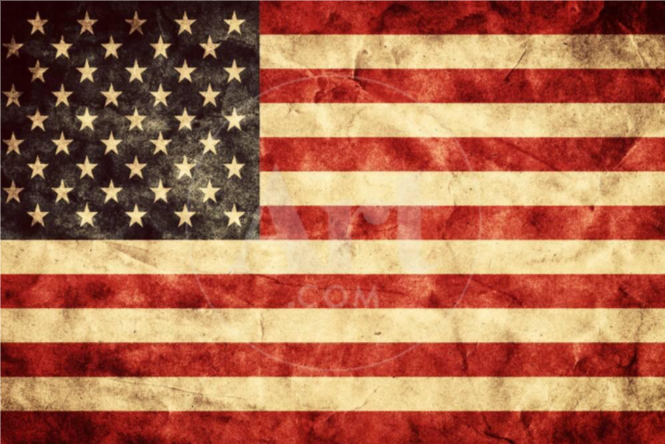
The American flag is an enduring symbol of resolve. For nearly 250 years, the flag has been representing the greatest experiment of freedom and liberty in the history of mankind. Born out of a year’s long struggle against tyrannical rule, the Stars and Stripes adorn the halls of the people’s government, leads armies and other forces of good against those that would oppress the right to liberty and self-determination; it is honored with pride and reverence in schools, community meetings and parades that celebrate the nation, its defenders and its peoples. It stands steadfast in defense of freedom, liberty and justice for all who cherish such tenets of democracy espoused in the Declaration of Independence, the Constitution and its Bill of Rights, and the Pledge of Allegiance.
The official flag of the United States consists of 13 red and white stripes representing the 13 original colonies. Its 50 white stars on a blue background today represent the 50 states.
Each of the colors on the flag have meaning:
- Red: valor and bravery
- White: purity and innocence
- Blue: vigilance, perseverance, and justice in a new constellation (country)
A star is added to the flag when a new state joins the United States. The flag was last modified on July 4, 1960, when Hawaii was incorporated as a state.
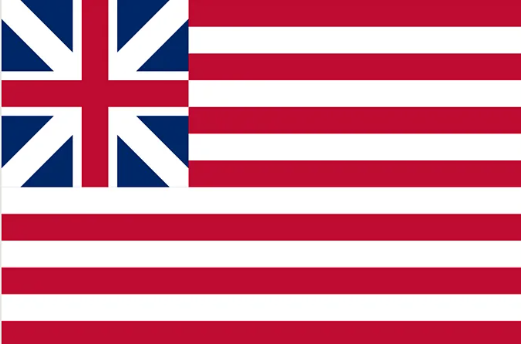
The first official American flag was established by the Continental Congress on 14 Jun 1777, with the “Flag Resolution.” However, the first flag used in rebellion against the British Crown by the seceding colonies was “the Continental Colors,” also known as the “Grand Union Flag,” adopted in 1775, which consisted of thirteen red and white stripes and the Union Jack in the upper-left-hand corner, also known as the canton. The flag symbolized the colonies’ desire for self-governance while still acknowledging loyalty to the British Crown, though after years of escalating tensions and conflicts with the crown’s tyrannical policies, the sentiment among most in the colonies was that a new and independent nation would be the only way to end the oppressive rule and guarantee self-governance and ensure self-determination.
On 14 Jun1777, the Second Continental Congress passed the “Flag Resolution,” which stated simply: “Resolved, that the Flag of the thirteen United States shall be thirteen stripes, alternate red and white; that the Union be thirteen stars, white on a blue field, representing a new constellation.”
Though now official, the specific arrangement of the stars in the “new constellation” was generally left to the flag makers. This not only led to various interpretations but gave rise to the legend of Betsy Ross designing the first flag. We have been taught for generations in school that George Washington commissioned Philadelphia seamstress Betsy Ross to create a new flag for a new nation in early 1776, a year before the Continental Congress would pass its resolution establishing the general design for a national flag. As told by her grandson in the 1870s, Betsy Ross was visited by Gen. Washington and several members of a secret committee established by the congress who would all agree to her suggested design. There are nearly as many variations to this story as there were stars on the original flag. Though the legend of Betsy Ross endures today, historians generally believe the story(s) to be a myth.
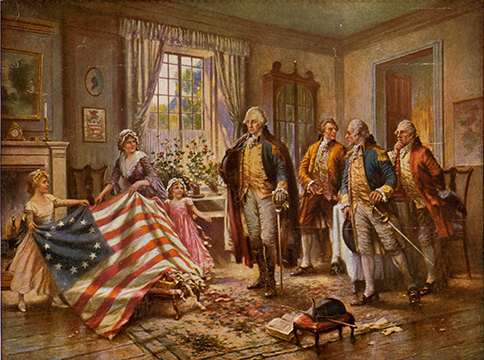
However, Betsy Ross was in fact a professional flag maker who made flags for the Pennsylvania Navy and it would certainly seem logical that Washington and the Continental Congress, housed in Philadelphia, would engage her to produce the new national flag; there is ample evidence to support the fact that she did produce many new United States flags from her shop.
As for the design, historians and scholars give credit to Francis Hopkinson, a lawyer, author, and signer of the Declaration of Independence as a delegate from New Jersey. Hopkinson designed two early versions of the national flag, one for the new United States and one for the navy, along with continental paper money and the Great Seal and first coin of the United States.
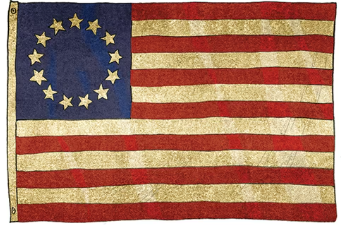
To date, there have been twenty-seven official versions of the flag, but the arrangement of the stars varied according to the flag-makers’ preferences until 1912 when President Taft standardized the then-new flag’s forty-eight stars into six rows of eight. The forty-nine-star flag (1959-60), as well as the fifty-star flag, also have standardized star patterns. The current version of the flag dates to July 4, 1960, after Hawaii became the fiftieth state on August 21, 1959.
A Very Curious Fact
The 1912 Taft orders were but a continuation of a long history of flag legislation. Previous acts had set the number of stripes and stars after states were admitted but never addressed design specifics like proportion and star arrangement. President Taft’s 1912 decrees and executive orders with respect to the standardized design of the national flag applied only to flags made for or by the federal government. As of 2025, there is still no federal law mandating a specific design for flags sold to the general public.