I pledge allegiance to the flag of the United States of America,
and to the republic for which it stands, one nation under God,
indivisible, with liberty and justice for all.
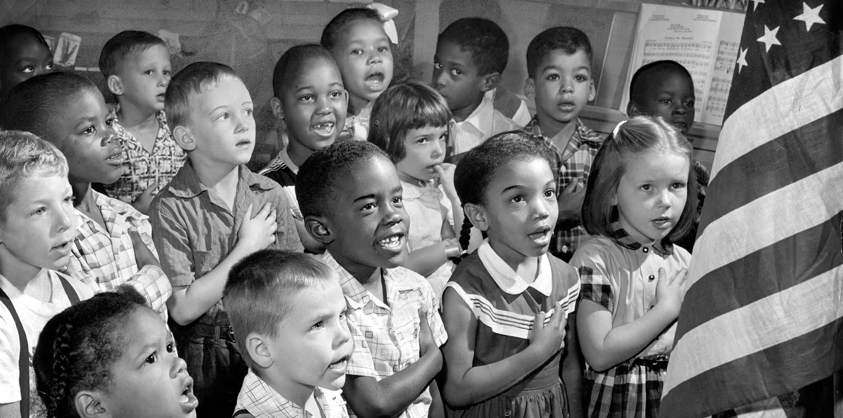
The Pledge of Allegiance was written in August 1892 by Francis Bellamy, a Baptist minister from New York. In 1891, Daniel Sharp Ford, publisher of The Youth’s Companion, a children’s magazine founded in 1827, hired Francis to work with his nephew, James B. Upham on the magazines flag promotion program begun in 1888. The magazine was a staunch supporter of the “Schoolhouse Flag Movement.” The goal was to place an American Flag in every classroom in the nation.
Bellamy penned the Pledge of Allegiance as part of this campaign, but he was an absolutist on the issue of the separation of church and state, intentionally excluding the phrase “under God.” It was published in the Sep 8th, 1892, issue of the magazine.
His original Pledge was written as:
I pledge Allegiance to my Flag and to the Republic for which it stands, one Nation indivisible, with Liberty and Justice for all.
But it was not without controversy, however, it would take fifty years and the rise of the Third Reich to emerge as such. Created by James Upham to accompany the pledge, Bellamy would incorporate and promote it; it would subsequently become known as “Belamy’s Salute” and be used in recital until 1942.
The Salute
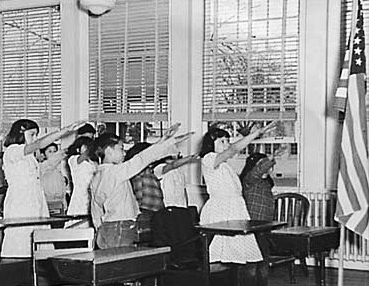
The Bellamy salute was first demonstrated on October 12, 1892, in honor of the National School Celebration of Columbus Day.
“At a signal from the Principal the pupils, in ordered ranks, hands to the side, face the Flag. Another signal is given; every pupil gives the flag the military salute – right hand lifted, palm downward, to align with the forehead and close to it. Standing thus, all repeat together, slowly, “I pledge allegiance to my Flag and the Republic for which it stands; one Nation indivisible, with Liberty and Justice for all.” At the words, “to my Flag,” the right hand is extended gracefully, palm upward, toward the Flag, and remains in this gesture till the end of the affirmation; whereupon all hands immediately drop to the side.”
Fast forward to the 1920s and 30s to the rise of the Third Reich and the fascists in Italy who would adopt a similar salute. Concern began to spread throughout the country over what was now being perceived as a show of support for the Nazi regime by using the Bellamy salute.
The Pledge of Allegiance was officially recognized by the U.S. government on 22 Jun 1942, when Congress formally included it in the U.S. Flag Code. The official name, “The Pledge of Allegiance,” was adopted three years later in 1945.
Congress would also act in 1942 to remove the “Bellamy Salute” by amending the Flag Code on 22 Dec, replacing the salute with the instruction to salute the flag by “placing the right hand over the heart” when reciting the pledge.
In 1923, the words “to my flag” were replaced with ” to the Flag of the United States of America.” In 1954, in response to the Communist threat post World War II, President Eisenhower encouraged Congress to add the words “under God,” creating the 31-word pledge we say today.
On 14 Jun 1943 in the case of West Virginia State Board of Education v. Barnette, the Supreme Court ruled 6-3, that requiring public schoolchildren to salute the flag or recite the Pledge violated their First Amendment rights to freedom of speech and religion.
Title 4, United States Code, Chapter 1 (relevant excerpt)
Adopted by the National Flag Conference, Washington, D.C., 14-15 Jun 1923, and revised and endorsed by the Second National Flag Conference, Washington, D.C., 15 May 1924. Revised, adopted and confirmed by congress numerous times over the years with the latest such as P.L 115-305 115th Congress, Second Session, 28 March 2017.
§ 4. Pledge of Allegiance to the flag; manner of delivery
The Pledge of Allegiance to the Flag should be rendered by standing at attention facing the flag with the right hand over the heart. When not in uniform, service men (and women) should remove any non-religious headdress with their right hand and hold it at the left shoulder, the hand being over the heart. Persons in uniform should remain silent, face the flag, and render the military salute. Members of the Armed Forces not in uniform and veterans may render the military salute in the manner provided for persons in uniform.