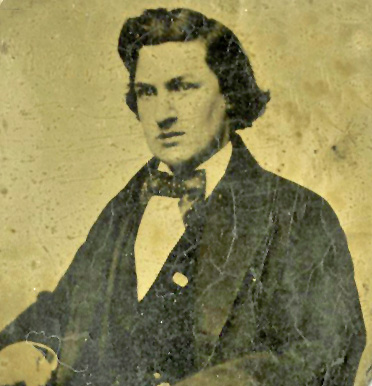
Descended from Old World Irish and Scottish stock, Junius Butler French was born 7 Aug 1837 in Fauquier Co., VA to James and Sarah Scarborough Butler (Henry) French, Junius was the fourth of five children to survive into adulthood. His father was a Planter by trade but would also serve three terms in the Virginia House of Delegates, representing Fauquier County. He would die on the 8th of May 1850 in Washington, DC and is buried there in the Congressional Cemetery.
Photograph Credit: Virginia Museum of History and culture.
Sarah French was the daughter of John and Martha (Williams) Henry and of the same Henry clan that produced the notable patriot and founding father, Patrick Henry, the man who uttered perhaps the most poignant defiance of tyranny in the history of the republic, “Give me liberty, or give me death!”
Sarah would outlive her husband James by twenty-three years, dying on the 9th of April 1873, in NY. She is interred at the Green-Wood Cemetery in Brooklyn, NY.
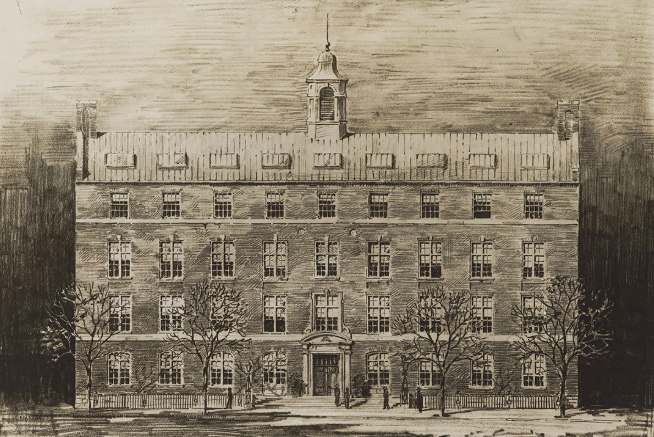
As a young boy of five, Junius would attend the short-lived Warren Green Academy in Warrenton, Fauquier County, VA. The original site is currently home to the old Warren Green Hotel (ca. 1874/76), which since 1960 has been home to the county administrative offices and public meeting hall. Formerly the Norris Tavern, it was built by Thaddeous Norris and operated from 1819 to 1842. In 1842 it was sold to Richard M. Smith, who established the Academy; for the next eight years, the school specialized in preparing young boys for higher education in prestigious institutions like the Virginia Military Institute.
In response to the rising demand for “classical” education in the 1840s, students at Warren Green Academy and other comparable schools were taught ancient languages, composition, mathematics and other subjects at a level deemed worthy of young men who would grow to become nation’s future leaders; young men who would pursue distinguished careers in the public and private sectors, or those who would pursue military careers.
Junius would spend seven years at the academy before his family removed to Washington, DC. By then, at age twelve, he was enrolled in Columbian College where he studied until the death of his father the following year.
After his father passed in May of 1850, Junius would be sent to a boarding school in Prince William County run by a brother of future Confederate General, Richard Ewell. He would remain at the boarding school until joining his mother and sisters in Brooklyn, NY sometime in 1853.
Fearless and high-spirited, a young Junius would often take great risks with his thrill-seeking adventures. One such occurrence with an older brother found a rock-steady Junius holding a tin cup by the bottom on his outstretched fingers, while his brother fired several shots with a pistol, placing all the shots so neatly in the center that they nearly touched. He also showed a healthy appetite for learning, reading as much as time and the written word would afford him; this thirst for knowledge would serve him well through his pursuit of higher education and success as a young attorney.
Before heading to the University of Virginia though, Junius would join his older brothers James and Marcellus on the western frontier of Texas. His mother had tried to put her spirited young son to business in New York, but it was not in Junius’ character and certainly not within his tolerance to relegate himself to what he viewed as a mundane life of fruitless, menial labor. The western frontier would also bring a return of his penchant for risky antics, one of which would ultimately lead to an unfortunate accident.
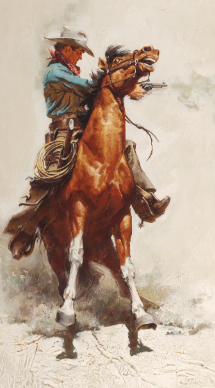
While riding his horse and practicing his shooting skills with his pistol, he would accidentally shoot himself in the leg; with no immediate medical assistance available, he would treat the wound himself as painful and risky as it was.
He would return to New York City in the spring of 1856, stay for a time, then leave for Charlottesville, VA to attend the University of Virginia from 1857-1859, where he would study law. In 1859 he would leave the university for the Richmond Hill Law School, founded by North Carolina Chief Justice Richmond Mumford Pearson in Richmond Hill, NC.
Upon completing his study, he would obtain a license to practice law throughout the state’s county courts in December of 1860. He would begin his law career working for Superior Court Judge James Walker Osborne in Charlotte.
No sooner than he hung out his shingle, the dogs of war would begin to bark. Junius would voice his support for the southern cause through discourse and debate, even making his way in April 1861 to Charleston, SC to witness the opening salvos of what would become the nation’s most devastating crisis of conscience and consequence. Upon returning to Charlotte, Junius enlisted days later with the “Hornets’ Nest Rifles,” a local company of riflemen that would be absorbed into the 1st North Carolina Volunteer Infantry under the command of Col. Daniel H. Hill, then the Superintendent of the North Carolina Military Institute of Charlotte.
The 1st North Carolina would join Col. John B. Magruder’s forces near Hampton on the Virginia Peninsula to support Col. Magruder’s defensive lines set-in place to defend against any Union assault up the peninsula towards Richmond. Early on Monday, 10 Jun 1861 near Big Bethel Church, what many consider to be the first land battle of the Civil War began when Union forces under Col. John Bendix of the 7th New York began firing upon their own, the 3rd New York Regiment under Brig. Gen. Ebenezer Peirce, mistaking them for Confederate Cavalry coming up on their rear. This disastrous mistake alerted Col. D.H. Hill’s 1st North Carolina Regiment and the “Richmond Howitzers” under Major George W. Randolph who manned their trenches, bracing for the assault they knew was imminent. Union forces launched several attacks on the Confederate positions throughout the day but were roundly repulsed each time.
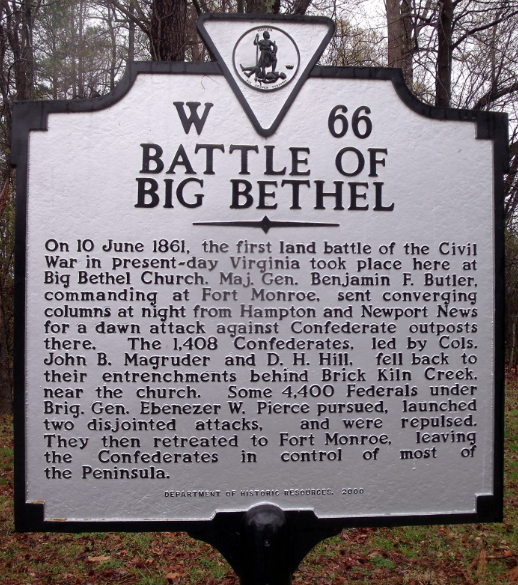
Though comparatively small in its scale compared to what was to come over the next three-and-a-half years, the overwhelming defeat of the Union that day was a tremendous morale booster for the fledgling Confederacy and would be the catalyst for several major campaign victories in the Eastern theater for the southern armies in the first two years of the war.
With no other involvement in the theater over the next few months, the short-lived history of the 1st North Carolina Volunteers would come to an official end on 12 Nov 1861 with the unit being re-organized and incorporated into the 11th North Carolina infantry Regiment; very few veterans of the 1st would join the new regiment, they would enlist elsewhere or simply go home, their term of service having expired.
Junius would reenlist on the 12th of March 1862 and muster the following month with Capt. John Y. Bryce’s Company K of the 42nd North Carolina Infantry Regiment under Col. George C. Gibbs. He would soon be detached from the company on 22 April, securing an appointment as regimental sergeant major. The 42nd would see little more than guard duty in Petersburg, a skirmish near Tarborough, NC and several small skirmishes with the enemy while assigned to outpost duty along the Blackwater River near Franklin, VA over the next several months. Sgt. Major French would be transferred on 6 Jun 1863 to the 23rd North Carolina Infantry Regiment under command of Colonel Robert D. Johnston. He would be appointed Adjutant with the rank of 1st Lt. The 23rd Regiment was attached to Brigadier General Alfred Iverson’s Brigade of Maj. Gen. Robert E. Rodes’ Division, Lt. Gen Richard S. Ewell’s 2nd Corps, Army of Northern Virginia. Gen. Ewell had just taken command after the death of Stonewall Jackson at Chancellorsville (Guinea Station) the month before.
Lt. French would join the 23rd on their march north after the Battle of Chancellorsville while encamped near Fredericksburg. The regiment would move north with the Army of Northern Virginia as it began its second campaign to bring the war to the north. Passing through Winchester, they would press on to Martinsburg where they cut the Baltimore & Ohio Railroad, then cross the Potomac River at Williamsport by the 15th of June. The regiment would continue to Chambersburg, PA and then to Carlisle by the 27th, where they would bivouac at the Carlisle Federal Barracks. The march north would see the 23rd posted as provost guard at several points along the army’s route north.
The 23rd would leave Carlisle Barracks on the morning of the 30th of June and march directly south toward Gettysburg, hearing battle as they drew near. Gen. Iverson’s brigade’ mission was to outflank, by an assault on their right flank, elements of Major Gen. John F. Reynolds’ 1st Corps, now under command of Maj. Gen. Abner Doubleday, at Oak Hill, the northernmost point of Seminary Ridge. Gen. Reynolds was killed around 10 a.m. that morning, during the opening hours of the battle while directing his troops on McPherson’s Ridge.
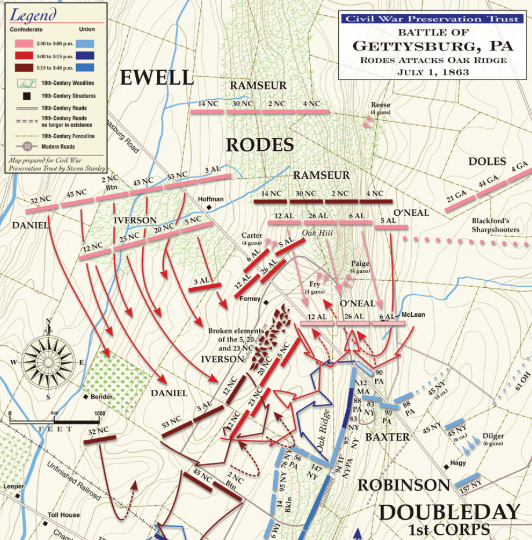
The Brigade, consisting of the 5th, 12th, 20th, and 23rd North Carolina Infantry Regiments, was formed into battle lines and ordered to advance across Forney’s field towards a line of trees about 300 yards away along Oak Ridge. Gen. Rodes’ initial plan was to deploy a single brigade along a single front, but upon arriving on the field changed his plan, he would deploy Iverson’s Brigade, along with Col. Edward O’Neal’s simultaneously on the left, then sending Brig. Gen. Junius Daniel’s brigade in on the right flank. Brig. Gen. Stephen Ramseur’s brigade would be held in reserve. Unfortunately, the most feared blunder of all blunders, “clear and concise communication,” would lead to complete and utter disaster for both Iverson and O’Neal; none of the brigade commanders knew what the signal to advance would be, and none of them, including their commander, Gen. Rodes, made any attempt at reconnaissance on the field or to deploy skirmishers ahead of their advance.
The resulting assault on Union Col. John C. Robinson’s 1st Division was fierce but immediately repulsed as Robinson’s men stood strong, being hidden behind a low stone wall, while Iverson and O’Neal floundered. Col. O’Neal would not only fail to send in all his brigade, but he would also remove to the rear, standing with the 5th Alabama Regiment, who had been held in reserve to man the gap between his and Brig. Gen. George Doles’ Georgia brigade on the extreme left flank.
Though outnumbering their foe, Col. O’Neal’s advancing troops were essentially massacred by Col. Robinson’s Division who rained down on the advancing confederates with heavy fire from Col. Henry Baxter’s brigade and cannister from Capt. Hubert Dilger’s Battery I, 1st Ohio Light Artillery. Capt. Digler, a German artillery officer, had taken leave to join the American army, he would be awarded the Medal of Honor in 1893 for his heroics at the Battle Chancellorsville. With Col. O’Neal in the rear, his shattered regiments were left on the field with no direction; nearly 35% of O’Neal’s three regiments were killed or wounded in that engagement.
As O’Neal’s battered regiments fell back, they exposed Col. Iverson’s flank to the same heavy fire that had decimated them. Iverson would fare no better, making the same critical mistakes as O’Neal. After “waiting to see” how Col. O’Neal’s advance would materialize, Iverson would hold his position rather than advance with his force. When his brigade began to move forward, Iverson would stay to the rear thus leaving the advance uncoordinated. The brigade marched through the field as if on parade while heavy artillery fire pummeled their ranks, causing the line to shift and head towards the low stone wall where the brigades of Baxter and Brig. Gen. Gabriel Paul were still in place. When Iverson’s men got within fifty yards of Baxter’s troops, Swiss born commander of the 83rd New York, Lt. Col. Joseph A. Moesch shouted: “Up men, and fire.” In very short order, over 900 of Gen. Iverson’s men lay dead and dying, mowed down like stalks of corn during a vicious summer squall. They were simply slaughtered.
“The men are no longer human, they are demons, a curse from the living here, a moan from the dying there. – Unknown Observer
Col. Robinson then ordered his troops forward; they would descend upon the remains of Iverson’s regiments and capture most all of those left standing. Gen. Iverson watch on in horror as his men were slaughtered on the field. After viewing the carnage with Gen. Rodes and watching scores of his wounded and dying troops waving handkerchiefs and rags in surrender, he would suffer a nervous breakdown and quickly be relieved and deemed unfit for further command.
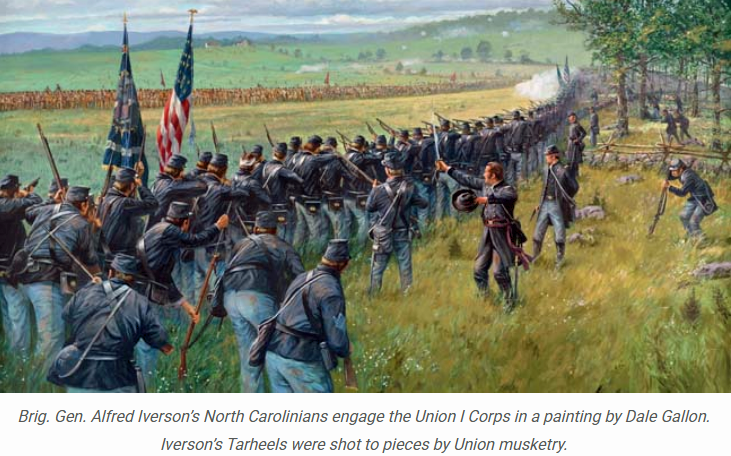
In the center of the assault was the 23rd North Carolina Regiment and 1st. Lt. Junius Butler French. Walking up and down the lines, urging his men forward, Junius was struck by a shot to his foot, shattering the bones and taking him down. While on the ground, he would be hit by two additional shots, one of which entered his upper thigh and traversed upward and into his abdominal cavity. Taken from the field and rendered aid at a makeshift field hospital on the grounds of the Jacob Hankey farm behind the lines about two and one-half miles west of Gettysburg along the Mummasburg Road. Junius would cling to life through the night and into the following morning but sadly pass away from his wounds on 2 Jul 1863.
He was buried on the grounds of the farm with a simple wooden marker along with approximately one hundred of his comrades who had suffered the same fate in the bloodied fields that once stood with rows of golden summer corn and wheat.
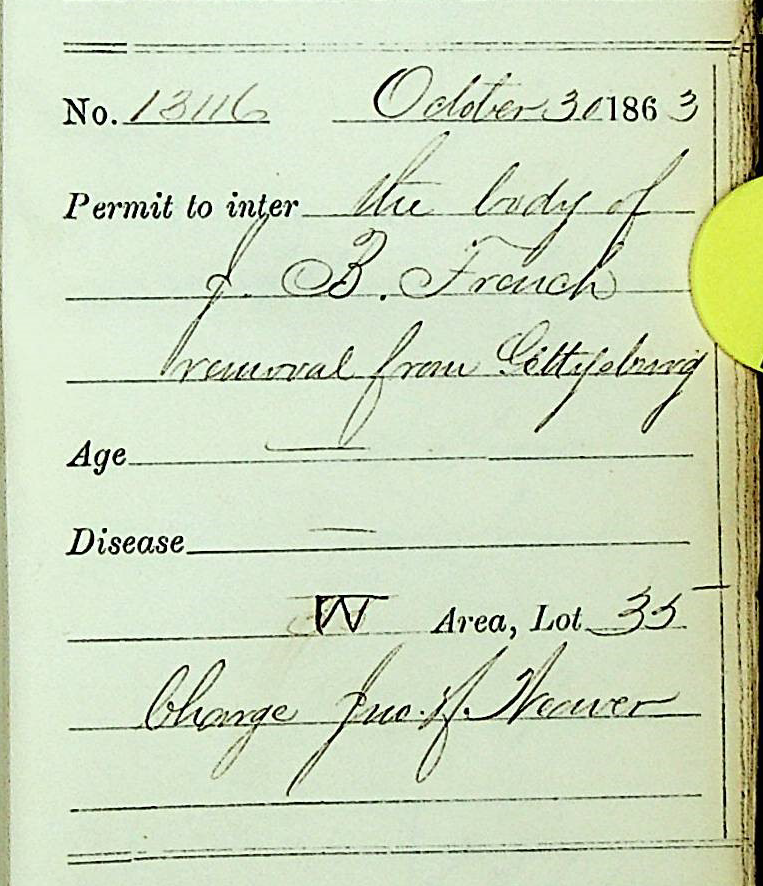
Through the efforts of his brother-in-law, Arthur H. Brown, husband of his sister Rosalie, and Baltimore Undertaker John H. Weaver, Junius’ remains would be disinterred and removed to Green Mount cemetery in Baltimore, MD at the end of October that year, where they would be placed in one of Weaver’s vaults, awaiting future plans for permanent interment.
In a rather curious twist to the death and reinterment of Lt. Junius Butler French, his temporary wooden marker would be left in place on the Jacob Hankey farm long after his remains had been removed to Green Mount Cemetery, even to be captured by a census of battlefield burials in 1866. The marker would eventually be retrieved and passed down through members of the French family and eventually to the collections of the Virginia Museum of History of Culture.
Junius would remain in the vault at Green Mount Cemetery with seemingly no movement as to where and when his body would be reinterred in a fitting and proper grave. Unfortunately, Arthur Brown would die of Yellow Fever the following August, and for the next several years, no efforts made to provide for Junius’ permanent place of rest. In August of 1870, a letter from Junius’ older brother Marcellus to their mother Sarah suggests that they remove Junius to Hollywood Cemetery in Richmond, VA, the final resting place for thousands of Confederates soldiers and sailors, and other officials, including Jefferson Davis and many southern generals. He also offered to have his brother’s remains buried on his farm in Pittsylvania County, Va. There appears to be no further communication regarding Marcellus’ suggestions and Junius remains in the Weaver vault.
Sarah French would die on the 9th of April 1873, in Brooklyn, NY and interred in Green-Wood Cemetery there. In September of the following year, Junius’ sister Rosalie would write in response to an assumed request for payment to John Weaver in Baltimore asking that he allow her to make payments on an installment basis for the care and storage of her brother’s remains. In October, she would receive a letter in return, along with a receipt of payment, presumably the first installment. To date, there exists no further record of payment or correspondence between Rosalie or any member of the French family and John H. Weaver.
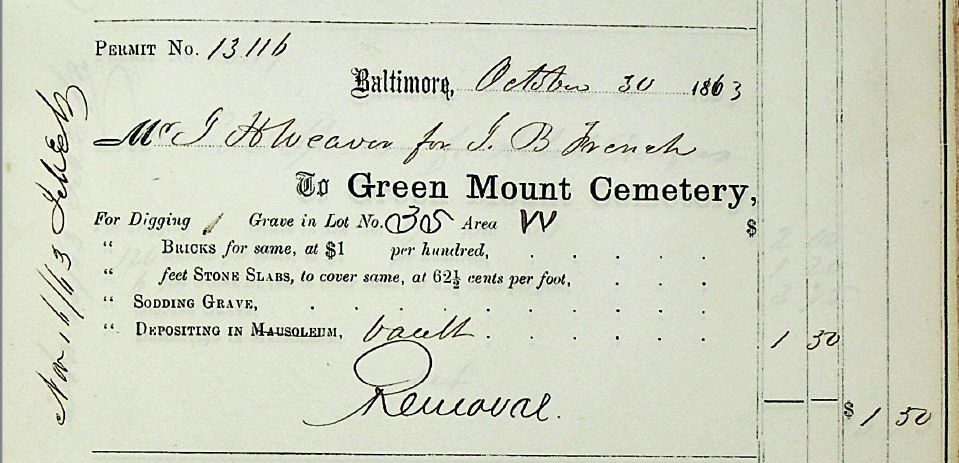
Records from the cemetery show that Junius’ body was eventually removed from Weaver’s vault and buried in an adjoining lot where he lies today in eternal rest.
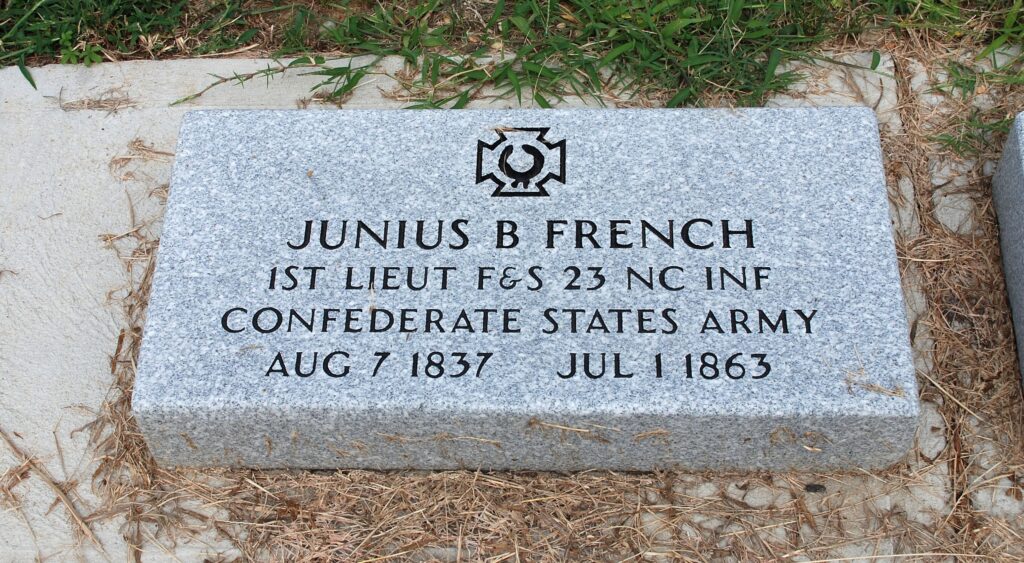
His location was discovered through a search of cemetery burial permits in early 2020 and a government marker procured from the Veterans Administration by the Northern Chesapeake Heritage Foundation. The marker was placed in June of 2020.