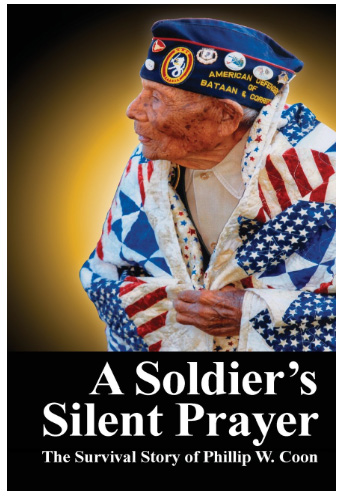
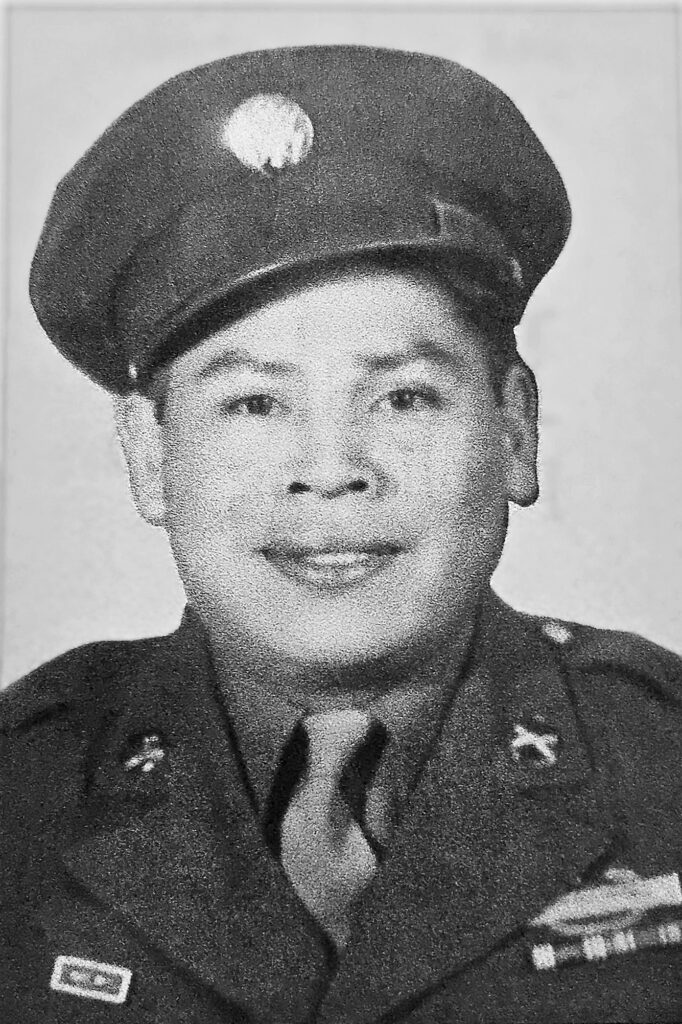
From a small Indian community near Mason, Ok, Phillip W. Coon would join millions of Americans in answer to the call to defend America after the Japanese attack on Pearl Harbor on 7 Dec 1941. Surviving the brutal, forced 65 mile “Bataan Death March” in intense tropical heat without adequate food or water after the humiliating US defeat in the Battle of Bataan in April 1942, Phillip would spend the next three-and-a-half years as a Japanese prisoner of war during World War II.
Cpl. Phillip William Coon was born 28 May1919 to Taylor and MaSallie (Johnson) Coon in Okemah, Ok. A full-blood Muscogee Creek, born into the Alligator Clan of the Nuyaka Trial Town of the Muscogee (Creek) Nation in Oklahoma. After graduating from Euchee Indian Boarding School in Sapulpa, Oklahoma and Haskell Institute, Lawrence, Kansas, Phillip volunteered for overseas duty with the United States Army. Assigned to the 31st Infantry Reg. PFC Coon was ordered to Fort McKinley in the Philippines, arriving on 23 Oct1941, and assigned to H Company, as a .30 caliber machine gunner and along with his company, would soon engage the Japanese in the Battle of Bataan not long after the attack on Pearl Harbor brought the US into WWII.
After the defeat of the American and Filipino forces, PFC Coons and approximately 75,000-80,000 American and Filipino prisoners were forced to endure a 65-mile march in the intense tropical heat without adequate food or water, enduring ridicule, taunting, and beatings simply for the pleasure of their Japanese captors. Thousands would die before the prisoners reached their destination, Camp O’Donnell, a Japanese POW Camp that would be forever remembered for the cruelty and death it became synonymous with.
Phillip Coon credited his will to survive to his faith in God, or as would say, “we ran out of food, ammunition and men, but we didn’t run out of prayer.” He was soon moved and would spend the next two years at POW Camps Cabanatuan, Lipa-Batangas, Murphy-Rizal, and Bilibid. On 1 Oct 1944, he was shipped via Hong Kong on the Hellship “Hokusen Maru” to Taiwan where he was held briefly at the Inrin Temporary POW Camp. From Taiwan he was sent to Moji, Japan, via the Hellship “Melbourne Maru” arriving 23 Jan1945, at which time he was transported north to Sendai #8B Kosaka POW Camp where he became a slave laborer mining copper for Fujita Gumi Kosaka Kozan at the.
Liberated in September 1945, Phillip returned to the United States and was discharged from service as a Corporal on 24 Jun1946. He would marry, raise four children and live to see the births of numerous grandchildren and great-grandchildren.
Cpl. Phillip William Coon is interred with his wife of 67-years, Helen, in Fort Gibson National Cemetery in Muskogee County, OK.
Source: Obituary/Various Internet Resources.
About the Author
Sherry Wickliffe Kast has worked in the public relations field for more than 25 years, enjoying a career of promoting the organizations she’s worked for in both the nonprofit and corporate worlds, and is president of Kast Publishing, LLC. She has been fortunate to cross paths with so many intriguing people, but none as awe-inspiring as Mr. Coon. “A Soldier’s Silent Prayer” is the first biography written by Sherry. It has been a labor of love for her to write about such an incredible man and his survival story. Sherry is Cherokee and resides in Oklahoma.