“If you failed to walk, you were killed. If you fell down, you died. If you had a dysentery attack, you died. If you had a malaria attack, you died. If you could only walk ten yards, and then fell down, you died.”
SSgt. Lester Tenney, a tank commander with the 192nd Tank Battalion and survivor of the horrific, inhumane Bataan Death March in April 1942, was honored during the 2002 National Memorial day Concert on the west lawn of the United States Capitol Building in Washington, D.C. His story, a powerful testiment to courage, resilience, and determination was shared with America by actor Charles Durning, himself a veteran of D-Day and the Battle of the Bulge.
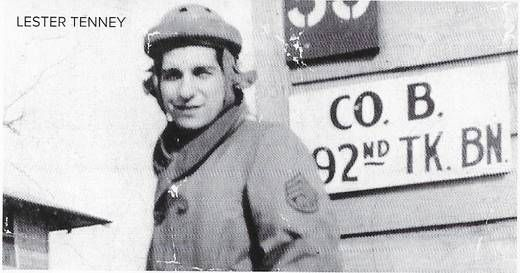
Born in Chicago on 1 Jul 1920, to Augustave and Fannie (Goldsmith) Tenenberg, Lester Tenney joined the National Guard in November of 1940, in part to get his year of service in before being subjected to the draft, so that he could move on to finish school and begin his career in business. His unit, the 192nd Tank Battalion, was mobilized that same month and after training in Kentucky, deployed to the Philippines in November of the following year, arriving on Thanksgiving Day, 1941.
The 192nd was positioned at Fort Stotsenburg, attached to Clark Field, twenty miles from Manila. In the weeks following the attack on Pearl Harbor, Japanese forces launched widespread military campaigns throughout the South Pacific, including the Philippines. In January 1942, they invaded Luzon, Philippines. For three months the American and Filipino forces fought valiantly despite shortages of supplies and munitions, but the overwhelming Japanese assault forced them to retreat to the Bataan Peninsula and ultimately proved too much in the end, forcing the surrender of approximately 12,000-14,000 American and 66,000 Filipino troops.
The Bataan Death March
On 10 Apr 1942, the Japanese began the forced march of their American and Filipino prisoners of war up the east coast of the Bataan Peninsula. Weakened by months of fighting, hunger, and disease, the POWs were forced to march on foot for four days without food or water while temperatures soared past 110 degrees.
The Japanese guards would take pleasure in torturing their prisoners and made a sport of wounding and killing the POWs by horrific means. They were beaten with rifle butts, shot, bayoneted, and even buried alive if they were too sick to march.
For upwards of ten days, depending upon the point at which any given new prisoner or group of prisoners were added to the column, the POWs marched roughly 65 miles until they reached San Fernando. At that point, the Japanese forced as many as 100 men into boxcars designed to hold no more than 40 people, resulting in many more deaths due to heat exhaustion and suffocation. At Capas, about 67 miles north of Manilla, the POWs disembarked and continued marching seven more miles to Camp O’Donnell.
The 65-mile Bataan Death March, plus the additional 7-miles from Capas to Camp O’donnell, was just the beginning of the Pits of Hell that SSgt. Lester Tenney and tens of thousands more would endure as Prisoners of War for the next three-and-a-half years. Though official reports vary, as many as 11,000 American and Filipino soldiers died during the Bataan Death March. Another 20,000 plus would die during the first two months of imprisonment at Camp O’Donnell. Many thousands more died of hunger, disease, exhaustion, physical abuse/torture, or execution at Camp O’Donnell and other Japanese POW camps.
Lester Tenney would dedicate his life to sharing his story, pursuing justice and reconciliation on behalf of those who endured or died as a result of the barbaric treatment at the hands of the Japanese military in WWII, and ensuring that history would never forget the sacrifices they made.
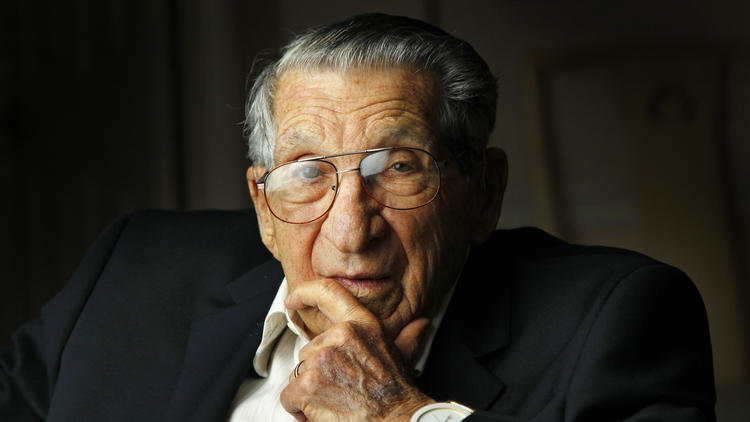
Learn more from SSgt. Tenney as he tells his story. From the Library of Congress’ “Veterans History Project.”