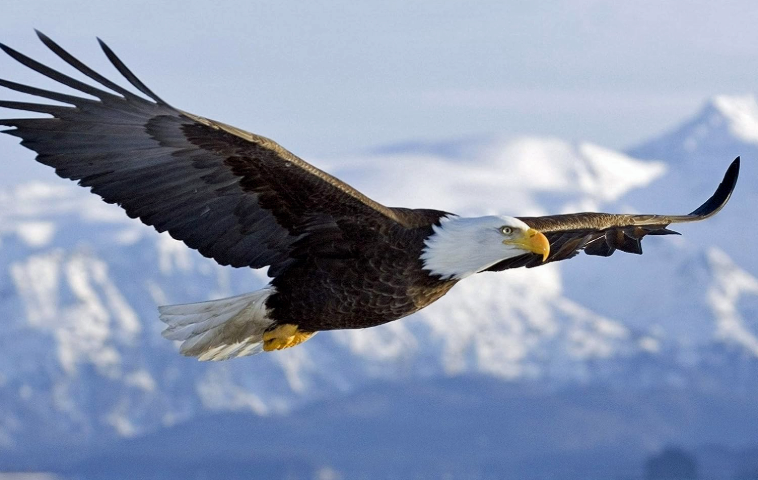
The American Bald Eagle was designated as the national emblem for the United States by the U.S. Congress in 1782, though it was not officially the “National Bird” until Christmas Eve, 2024. On that date, President Joe Biden signed into law, Senate Bill S. 4610, amending Title 36 of the U.S. Code, giving the bald eagle official status. It can be found on official documents, the Presidential Seal, the Great Seal, military insignia, and on coinage and paper bills.
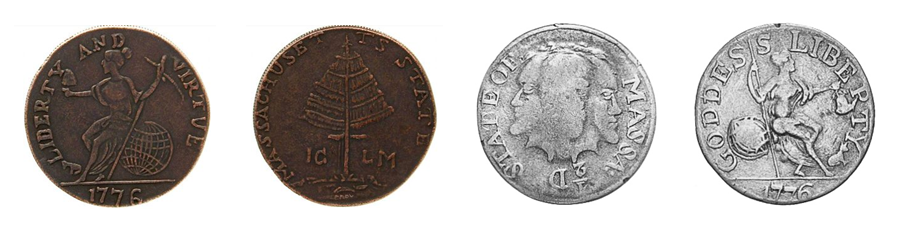
Contrary to a continuously propagated myth that just won’t go away, the American Bald Eagle did not make its first appearence on a Massachusetts one cent piece in 1776. In 1776 Massachusetts issued the Janus Halfpenny and the Pine Tree Penny pieces, both were designed by Paul Revere. The halfpenny featured a design that consisted of three conjoined heads on the front and the seated Liberty on the reverse. The Pine Tree Penny featured a pine tree on one side and a seated figure of Liberty on the reverse. It was not until 1787, under authorization from the Massachusetts General Court, that an eagle first appeared on a coin. The design featured an American Indian with a bow and arrow on the front and an heraldic eagle on the reverse.
The first use of a bald eagle on federal coinage occurred on the reverse of gold and silver coins mandated by the Coinage Act of 1792, which officially established the U.S. Mint, and required that all federal gold and silver coins feature a representation of an eagle. In 1795, the eagle made its first appearance on U.S. gold coins, the $5 Half Eagle and $10 Eagle.
The National Symbol
In the first year of formulating the U.S. government after the end of the Revolutionary War, congress would hold often bitter and contentious debates over what the national emblem should be. On 20 Jun 1782, the bald eagle was finally chosen to represent the new nation. Not all were on board though, including Benjamin Franklin, who would lead those opposed to the bald eagle’s status as the national symbol. In a letter dated 26 Jan 1784 to his daughter Sarah Bache in Philadelphia, though never sent, Franklin wrote (excerpts):
“For my own part I wish the bald eagle had not been chosen as the representative of our country. He is a bird of bad moral character. He does not get his living honestly. You may have seen him perched on some dead tree, where, too lazy to fish for himself, he watches the labour of the fishing hawk; and when that diligent bird has at length taken a fish, and is bearing it to his nest for the support of his mate and young ones, the bald eagle pursues him, and takes it from him.”
“For in truth, the turkey is in comparison a much more respectable bird, and withal a true original native of America. Eagles have been found in all countries, but the turkey was peculiar to ours, the first of the species seen in Europe being brought to France by the Jesuits from Canada and served up at the wedding table of Charles the ninth.”
Franklin was mistaken when generalizing in his statement with respect to eagles being found “in all countries,” the bald eagle was indigenous only to North America. Eagles everyhere had been mostly seen as symbols of strength, courage, freedom and immortality by many civilizations for generations.
Though many in congress had agreed with Franklin, he did not actually propose that the turkey become the national symbol, nor did he suggest later in his letter that it replace the bald eagle.
Nesting, Mating, and The Young
- Bald Eagles are believed to live 30 years or longer in the wild. The oldest recorded eagle in the wild was at least 38 years old when it was hit and killed by a car in New York in 2015.
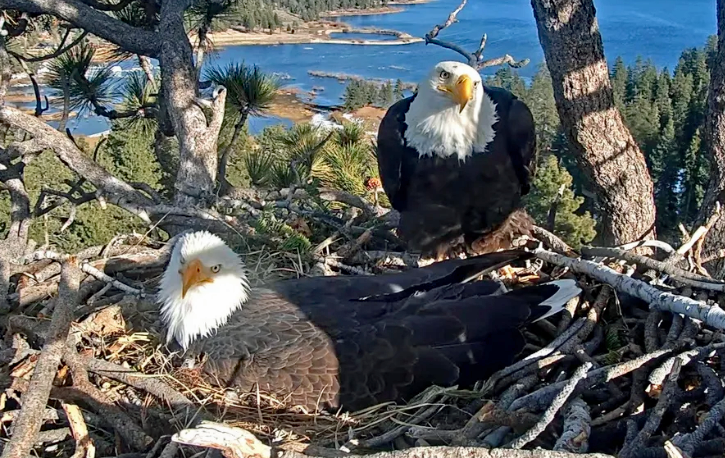
- They mate for life, building huge nests in the tops of large trees near rivers, lakes, and other wetlands, and they’ll use these nests forever, unless destroyed or compromised. The largest Bald Eagle nest on record, in St. Petersburg, Florida, was 2.9 meters in diameter and 6.1 meters tall.
- Females will choose the nesting tree, but both will build the nest. They will both scout and defend their nesting territory which is usually several square miles, depending on habitat and the proximity of other nesting eagles.
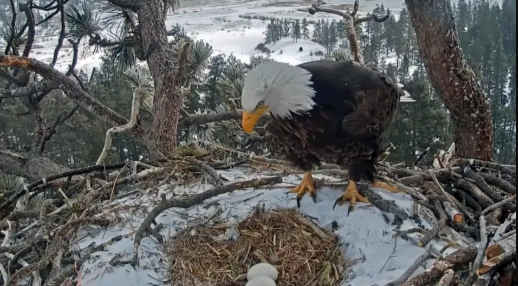
- The female will lay 1-to-3 eggs, 2-to-3 days apart, each being roughly 3-inches long and off-white in color. Both parents share in incubating the eggs and generally lasts about 35 days. Eaglets will stay in the nest for 11-to-12 weeks before the adults will start encouraging them to fly; they spend this time exercising their wings on the nest or on a nearby branch for a week or so prior to fledging (taking their first flight from the nest).
- Young Bald Eagles will spend their first 3-4 years living as nomadic birds, often flying great distances exploring vast territories. It is not uncommon for these juveniles to fly hundreds of miles or more per day during this time. Many young Bald Eagles have been recorded migrating from their birthplace in Florida to territories as far north as Michigan, and birds from California have reached Alaska.
- The distinctive white head and tail feathers appear when the eagles mature at 4 to 5 years old. Adults typically measure from 30 to 40 inches from head to tail, with a 7-to-8-foot wingspan, and weigh from 8-to-14 pounds, with the female being larger than the male.
- Eagles feed primarily on fish, but will also feed on ducks, rodents, snakes, and carrion. They occasionally hunt cooperatively, with one individual flushing prey towards another, but will also go after food caught by another bird or animal. A Bald Eagle will harass a hunting Osprey until the smaller raptor drops its prey in midair, where the eagle swoops it up. They have even been known to steal a fish off the line of a human angler.
- Young eagles generally return to within 100 miles or so of their own birth site when they reach maturity and are ready to mate. They will establish their own territory and will vigorously defend it, even against its own parents.
Decline & Recovery
Bald eagles once teetered on the brink of extinction… Learn More